What’s available from the Administrative Office of the U.S. Courts is usually a single number, like 9.7 months for a median length of time to final disposition. See my prior post. A range – rather than a single number – may prove more useful to you. Or, you may want to plan using a more conservative number, such as a 3rd quartile figure rather than a median. The problem is that you can’t get those numbers or ranges from the published statistics.
Over the last year, I collected information on Third Circuit cases terminated in fiscal year 2010, 2011 and 2012 (generally, the cases are those I could identify either through the Third Circuit’s archive or the archive of opinions available through Villanova University). Let’s just say that problems at a cellular level meant that I had a lot of time on my hands.
My data are not identical to the Administrative Office’s information. For example, to keep things consistent, I collected the date the appeal was docketed rather than the date a notice of appeal was filed. This was because original proceedings and cases from administrative agencies do not have a “notice of appeal” per se. My data do not include all judgment orders, and I have none of the court’s decisions regarding requests for certificates of appealability or regarding terminations based on the absence of a certificate of appealability. I did not exclude cases terminated through dismissals due to a lack of jurisdiction or mootness (terminations not on the merits) because appellants and appellees still have to wait for a decision in those cases and plan accordingly.
When I calculate the median length of time from docketing to final disposition in FY 2011, I get 321 days (or 10.55 months) – about 26 days longer than the 9.7 months reported by the Administrative Office of the U.S. Courts. The reason my number is higher is likely because I don’t have all the original proceedings (my data include 103 original proceedings cases; the Administrative Office’s data include 251 such proceedings decided on the merits) or terminations based on certificates of appealability. Original proceedings are usually terminated very quickly (the median is 1.6 months, see Judicial Business 2011, Table B-4D) and would tend to lower an overall median.
But here are some length-of-time results from my data:
25 % of cases were decided by 196 days (6.44 months);
50 % of cases were decided by 321 days (10.55 months, the median);
75 % of cases were decided by 483 days (15.88 months).
The smallest number of days it took to terminate a case was 3; the largest number of days it took to terminate a case was 3,406 (yes, that’s 9.3 years). Now, I wouldn’t want to give a client a range like 3 to 3,406 days in response to a “how long will it take” question. But based on these numbers, a conservative 3rd quartile-based estimate would be less than 16 months, and a conservative range would be between 6 and 16 months.
To “see” the data, I also broke the cases down into categories defined by 3-month intervals (e.g., the first category included cases terminated in the first 3-month period since docketing and so on through the 37th 3-month period). Here’s what the breakdown shows:

In FY 2011, the largest number of cases in my sample (419) were terminated in the fourth 3-month period, i.e., in the fourth quarter after docketing. Just over 63% of all the cases in my sample were terminated in the 2nd, 3rd, 4th, and 5th quarters (bars extending above the 200-case line). By the end of the 5th quarter (first 5 bars), over 78% cases had been decided. So, rather than give a client 9.7 months (or 10.55 months) as an estimate of the amount of time an appeal will take, you could give that client a range of between 6 months and 15 months (2 to 5 quarters).
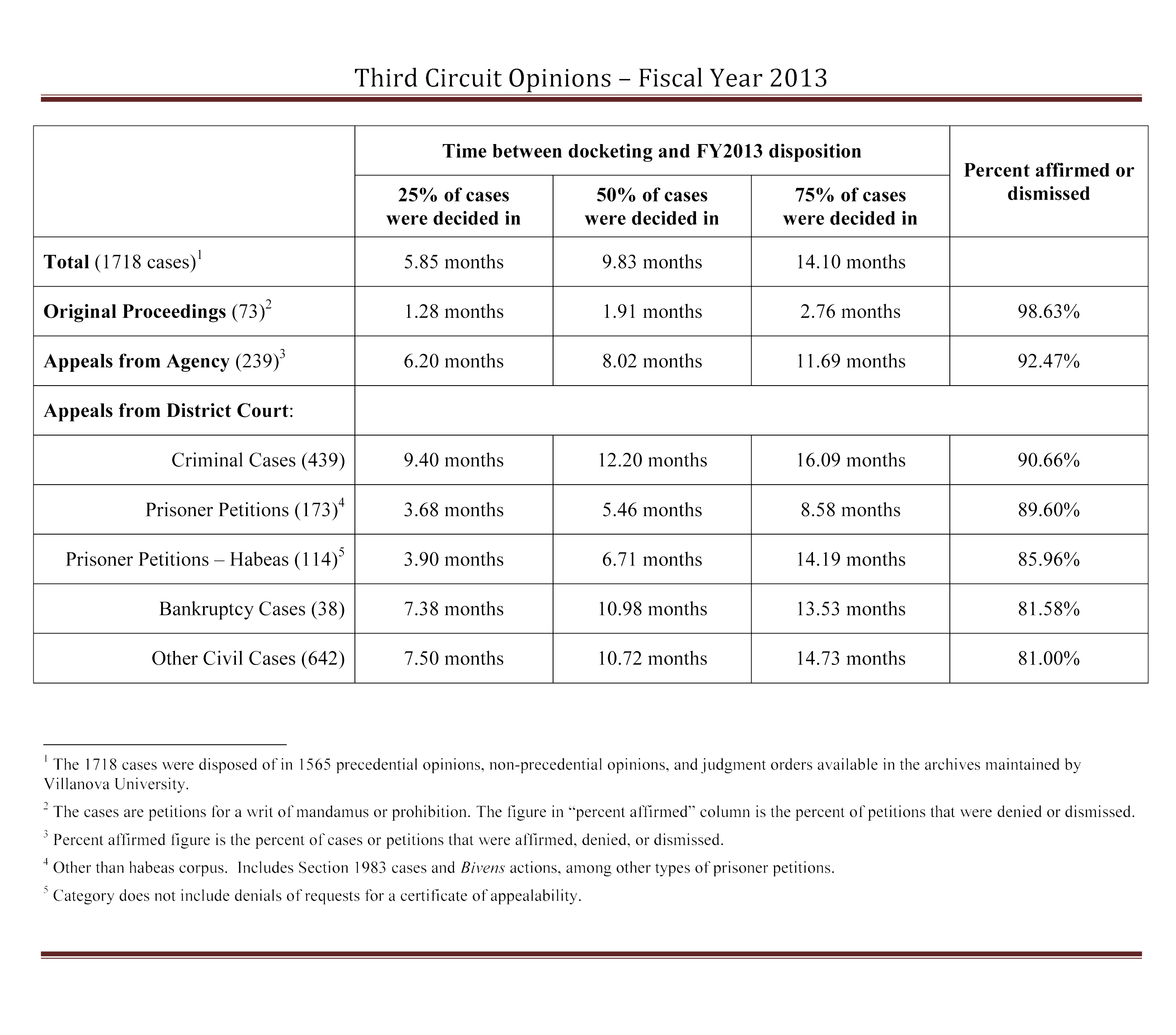
These ranges do not take into account the fact that different types of appeals take different lengths of time. Stay tuned for more on that subject.


 Once Upon Review