
To appeal or not to appeal – an example using Third Circuit contract appeals.

Switching from the employment-case scenario of my last post, now let’s say you just learned that the district court judge granted the opposing party’s motion for summary judgment in a breach-of-contract case. As before, you’re still within the period you have to file a notice of appeal. My data has 84 contract-case appeals the Third Circuit decided in FY 2013.

A bit of background on those 84 cases: About a third of them involved insurance policies. In about 30% of the 84 cases, the claims were dismissed, usually under Rule 12. In another 39%, the district court granted summary judgment. Judgment was entered after a bench or jury trial in another 12%. These percentages don’t add up to 100 – other cases came to the Third Circuit after decisions on injunctions, Rule 60 motions, as well as other motions. Some other statistics:

Time to disposition:    First quartile – 9.12 months
Median – 11.57 months
Third quartile – 14.73 months

Percent affirmed or dismissed:                      78.57%.

Time to disposition is about what it is for “other civil cases” generally, and the percentage affirmed or dismissed is slightly smaller. See FY 2013 statistics here. The percentage affirmed or dismissed is a good deal smaller than the comparable percentage for my sample of employment cases, though contract-case appeals also appear to take longer. See here.

A quick way to get an idea of whether it makes sense to appeal from the district court’s summary judgment decision in the contract case is to apply the above percentage to what’s on the table. If, for example, $100,000 is at stake – this is what you’ll get (or get to keep) if you win the appeal – then an estimate of the “expected benefit” of the appeal is $21,430. From that, you’ll have to subtract attorney fees and other costs associated with the appeal that you will have to pay.

Why only $21,430? If 78.57% of decisions in contract cases are affirmed or dismissed, then 21.43% (100-78.57) can be taken as an estimate of the chance that there will be some meaningful change to the district court’s decision – either it’s reversed or vacated in whole, or reversed or vacated in part. If you lose the appeal, you’ll be out attorney fees and other costs you have to pay and you will gain nothing (you will still be faced with the adverse district court decision and what that means for what you’ll have to pay or do without). If you are looking at fees and costs likely totaling more than $21,430, then you’ll have a negative expected value of the appeal. Generally, this means you should not appeal.

Now, if there’s $1M at stake, the expected benefit would be $214,300, and, unless your attorney’s fees and other costs are more than that, you’ll be looking at a positive expected value of the appeal.

This expected value example is a simple one; it does not include all the factors that you should consider when deciding whether or not to appeal. But it may give you a good – and objective – starting point.
Should you appeal your employment case?

How can you use statistics like the ones published on this site to help you decide whether to appeal a court judgment? Let’s say you just learned that the district court judge granted the opposing party’s motion for summary judgment in the Title VII case in which you’re a party, and you’re still within the period you’re allowed to file a notice of appeal. Statistics can give you some idea of what might happen once your case is on review (hence the name of this site, by the way – Once Upon Review). The statistics I’m going to address here are:

For Civil Rights – Employment cases (N=92):

Time to disposition: First quartile – 6.99 months
Median – 9.55 months
Third quartile – 11.91 months

Percent affirmed or dismissed 91.30%

In FY 2013, the Third Circuit decided 92 cases brought under employment-related statutes (e.g., Title VII, the ADA, the ADEA). I’m not including in this discussion cases brought under Section 1983 that allege some constitutional violation in the context of an employment relationship (e.g., retaliation for exercising First Amendment rights).

Of the 92 cases, 57 ended with a decision on a summary judgment motion (about 62%). Another 19% ended with a dismissal, usually on a Rule 12(b)(6) motion. Eight cases were brought to the Third Circuit after a jury or bench trial. Yes, I’m going by the data that I collected here – the Administrative Office’s published information doesn’t include such details.

By the time of the Third Circuit’s decision, those 92 cases had been on the appellate court’s docket from 65 days (minimum) to 1,196 days (maximum). The median time between docketing and disposition was 290.5 days, or 9.55 months. So, 50% of the 92 cases were decided in about 9½ months. Other statistics show that 25% of the cases were decided in about 7 months and 75% of the cases were decided in just under a year (362.25 days or 11.91 months). So, one way of looking at the statistics above is that they suggest that if you do appeal, you can expect that you’ll have to wait 9½ to 12 months to get a decision on the merits of your employment case. Obviously, a lot of things can happen to bring your specific case either under or over that range, but that range is a probably a good starting estimate.

Now, what you’re probably most interested in is your chances of success on appeal. Taking things from a general perspective – without delving into the specific facts of your case – one indicator of your chances of success is how often the Third Circuit affirms the district court decision. From an appellant’s perspective this is usually a complete loss, and conversely, from an appellee’s perspective, it is a complete win.

In FY 2013, the Third Circuit affirmed or dismissed 91.30% of the 92 cases described above.

Yes, that’s a high number. Yes, that’s a quite a bit higher than the 81% percent listed in my prior post for “other civil cases” – the category that includes the 92 employment cases. And finally, yes, that number means that you could wait a year only for the Third Circuit to tell you that you lose.

What the percent affirmed number doesn’t tell you is whether your specific case is like the cases in which the Third Circuit affirmed or whether it is more like the cases in which the Third Circuit reversed, reversed in part, vacated, or vacated in part the district court’s judgment (the remaining 8.7%). If someone is advising you to appeal, however, a good question to ask that person is how your case is more like the cases in the 8.7%.

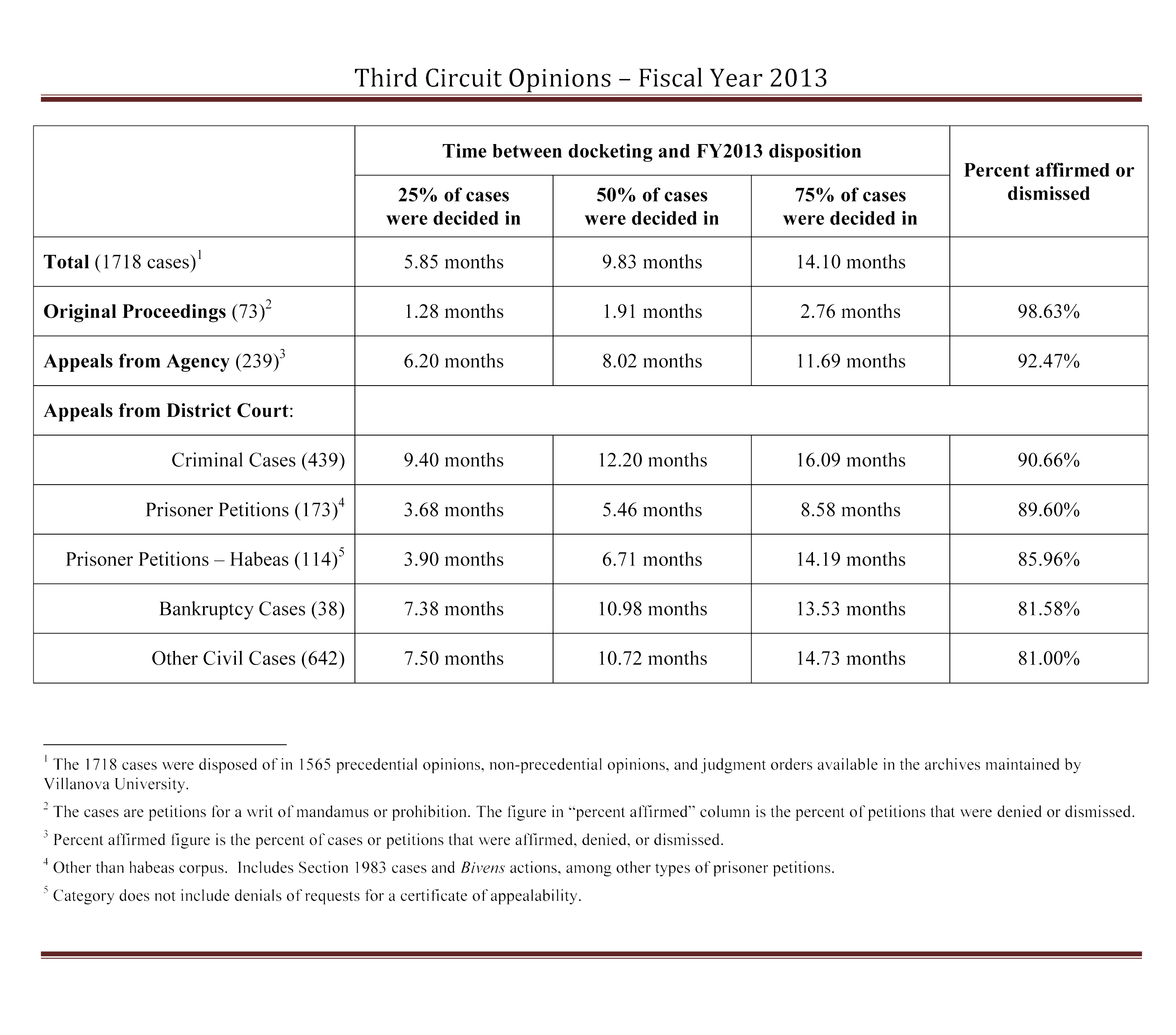
Here are some basic statistics on the Third Circuit’s decisions in FY 2013 (October 1, 2012 to September 30, 2013). Note that the percent affirmed or dismissed figures vary by case type, and range from 81% (other civil cases) to 92.47% (appeals from administrative agencies). Thus, for example, in just over 90% of criminal cases, the Third Circuit left the district court’s decision untouched. On the other hand, in just under 10% of those cases, the district court’s judgment was reversed, reversed in part, vacated, or vacated in part. The figures also show that nearly all petitions for writs of mandamus or prohibition are denied or dismissed.

Third Circuit Opinions – Fiscal Year 2013

Don’t believe the reported numbers – Your chances of getting a reversal in the Circuit Courts are not going down

A glance over the last two years of statistics reported by the Administrative Office may lead you to think that the chances of getting a “pure” reversal are going down. Of all terminations on the merits across all the regional circuit courts, statistics for the “percent reversed” went from 8.9% in FY 2011 to 6.8% in FY 2012.  See Judicial Business 2012, Table B-5 and compare the information there to Judicial Business 2011, Table B-5. In the Third Circuit, those percentages went from 9.4% in FY 2011 to 6.4% in FY 2012.  The numbers for the Fifth Circuit went from 8.0% in FY 2011 to 5.4% in FY 2012 and the Ninth Circuit went from 11.8% to 7.7% in the same period. In fact, all but two of the 12 regional circuits saw declines of some sort; only the Seventh Circuit’s numbers went up, and then did so by a small amount.  The numbers for the Sixth Circuit were unchanged.

I suppose that a change in the mix of cases could explain part of these declines.  It’s not unusual to see the numbers bounce over time in a single circuit court, going up one year and going down the next, likely because of the mix of cases that court terminates.  But these bounces tend to cancel each other out in the overall numbers because some circuits see declines while others see upticks.  This explains why the percent reversed across all circuit courts hovered around 9.6% (plus or minus .6%) between FY 1997 and FY2011.  So it is surprising to see 10 of 12 circuit courts move in the same direction and to see the overall percent reversed to go down by over two percentage points.

So what gives?  What I found is one of the frustrations of dealing with reported statistics – unexplained changes in the way data are handled.  Bottom line – the percent reversed figures reported for FY 2012 are not comparable to the earlier percentages.

If you go through the online version of the 2012 Judicial Business report, you’ll find a notation to changes the Administrative Office made to the way its data are reported. The percent reversed numbers above come from Table B-5, and the 2012 Report explains that Table B-5 now presents “data on cases disposed by consolidation” whereas in prior years Table B-5 “did not provide such data.”

Ok, but that change doesn’t explain what happened to the percent-reversed figures.  That’s because the “consolidation” change affected neither of the numbers used to calculate those percentages.

What the Administrative Office doesn’t explain (at least I couldn’t find it) is that another change in the way it did things in the 2012 Report was to now treat certificate of appealability terminations as terminations on the merits. See that column labeled “Cert. Appealability” under the overall heading of “Terminations on the Merits” in Table B-5 of the 2012 Report? That column does not appear in Table B-5 in the 2011 or 2010 reports. In those reports – and in fact in all reports going back to 1997 – the “Cert. Appealability” column is in Table B-5A because those dispositions were considered procedural terminations, not merit terminations.  Why are certificate of appealability terminations all of a sudden merit terminations?  No clue.

The effect of the change, however, is to make the number of cases terminated on the merits larger, and as a result, to reduce the percentage of cases reversed.  So the 3 percentage point decline in the Third Circuit probably has more to do with the fact that certificate of appealability terminations represented over 14.5% of the total number of dispositions on the merits than anything having to do with how judges see things. Taking certificate of appealability terminations out of the base leads to a “revised” percent reversed of 8.3% for all circuits, and of 7.5% for the Third Circuit – both still smaller than in FY 2011, but not by huge margins.  The revised percent reversed for the Ninth Circuit is 11.25%, a mere .5% decline from the FY 2011 figure.  Although the change in the way certificate of appealability terminations are treated doesn’t explain all the declines in the reported statistics (e.g., the percent reversed in the D.C. Circuit went from 15.0% to 8.9%, but that court had only 7 certificate of appealability terminations in 2012), it does explain a sizeable portion of them.

How long will an appeal take – Part II

What’s available from the Administrative Office of the U.S. Courts is usually a single number, like 9.7 months for a median length of time to final disposition. See my prior post. A range – rather than a single number – may prove more useful to you. Or, you may want to plan using a more conservative number, such as a 3rd quartile figure rather than a median. The problem is that you can’t get those numbers or ranges from the published statistics.

Over the last year, I collected information on Third Circuit cases terminated in fiscal year 2010, 2011 and 2012 (generally, the cases are those I could identify either through the Third Circuit’s archive or the archive of opinions available through Villanova University). Let’s just say that problems at a cellular level meant that I had a lot of time on my hands.

My data are not identical to the Administrative Office’s information. For example, to keep things consistent, I collected the date the appeal was docketed rather than the date a notice of appeal was filed. This was because original proceedings and cases from administrative agencies do not have a “notice of appeal” per se. My data do not include all judgment orders, and I have none of the court’s decisions regarding requests for certificates of appealability or regarding terminations based on the absence of a certificate of appealability. I did not exclude cases terminated through dismissals due to a lack of jurisdiction or mootness (terminations not on the merits) because appellants and appellees still have to wait for a decision in those cases and plan accordingly.

When I calculate the median length of time from docketing to final disposition in FY 2011, I get 321 days (or 10.55 months) – about 26 days longer than the 9.7 months reported by the Administrative Office of the U.S. Courts. The reason my number is higher is likely because I don’t have all the original proceedings (my data include 103 original proceedings cases; the Administrative Office’s data include 251 such proceedings decided on the merits) or terminations based on certificates of appealability. Original proceedings are usually terminated very quickly (the median is 1.6 months, see Judicial Business 2011, Table B-4D) and would tend to lower an overall median.

But here are some length-of-time results from my data:

25 % of cases were decided by 196 days (6.44 months);
50 % of cases were decided by 321 days (10.55 months, the median);
75 % of cases were decided by 483 days (15.88 months).

The smallest number of days it took to terminate a case was 3; the largest number of days it took to terminate a case was 3,406 (yes, that’s 9.3 years). Now, I wouldn’t want to give a client a range like 3 to 3,406 days in response to a “how long will it take” question. But based on these numbers, a conservative 3rd quartile-based estimate would be less than 16 months, and a conservative range would be between 6 and 16 months.

To “see” the data, I also broke the cases down into categories defined by 3-month intervals (e.g., the first category included cases terminated in the first 3-month period since docketing and so on through the 37th 3-month period). Here’s what the breakdown shows:

TableBar copy

In FY 2011, the largest number of cases in my sample (419) were terminated in the fourth 3-month period, i.e., in the fourth quarter after docketing. Just over 63% of all the cases in my sample were terminated in the 2nd, 3rd, 4th, and 5th quarters (bars extending above the 200-case line). By the end of the 5th quarter (first 5 bars), over 78% cases had been decided. So, rather than give a client 9.7 months (or 10.55 months) as an estimate of the amount of time an appeal will take, you could give that client a range of between 6 months and 15 months (2 to 5 quarters).

These ranges do not take into account the fact that different types of appeals take different lengths of time. Stay tuned for more on that subject.